
AI and Data Centers in 2026: Why Electricity Is Becoming Tech's Biggest Bottleneck
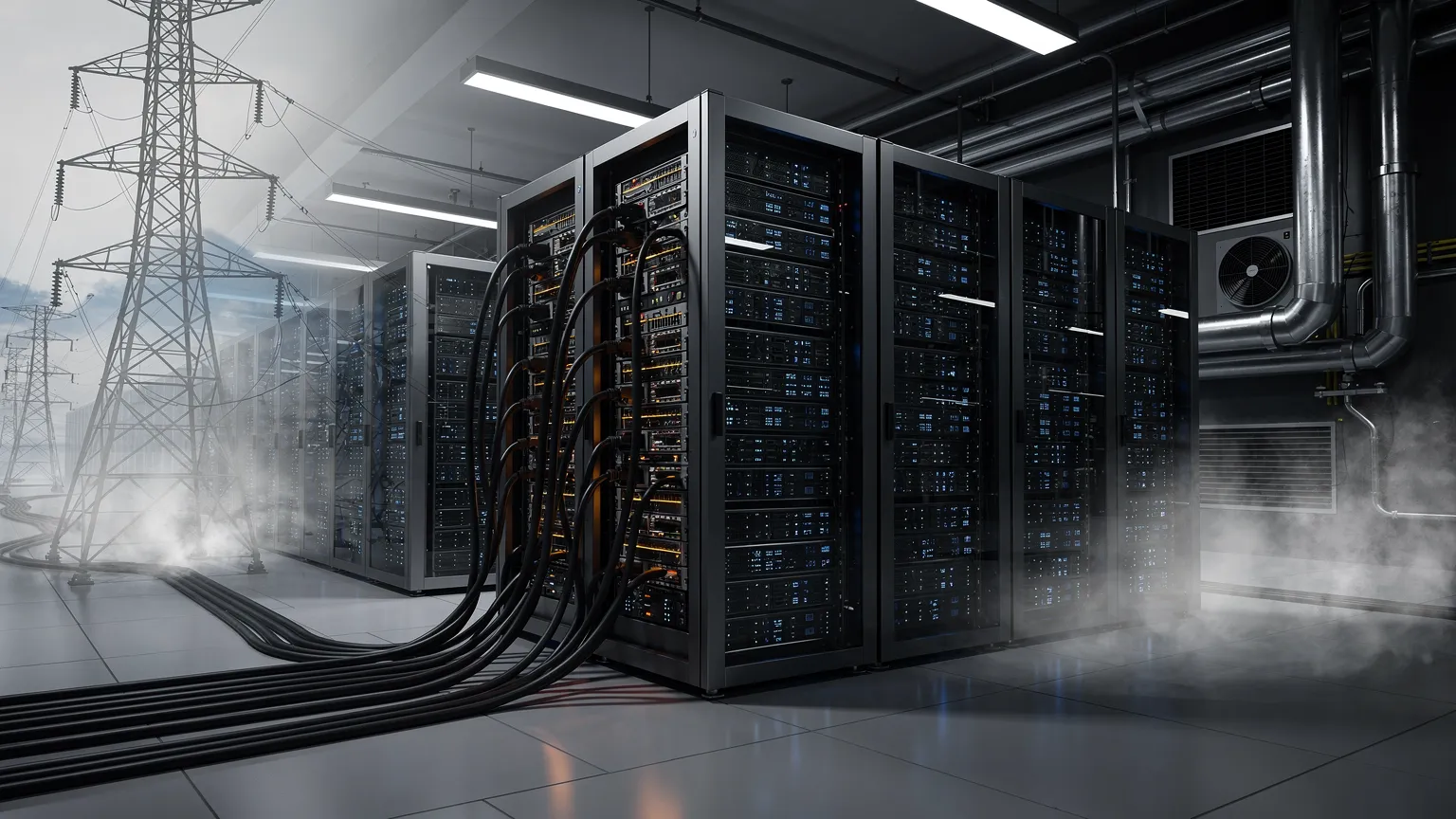
AI is transforming data centers into major electricity consumers. Explore the latest 2026 IEA figures, the role of GPUs and cooling, grid bottlenecks, environmental trade-offs, and what rising energy demand means for the technology industry.
Artificial intelligence is often described as a software revolution, but every AI application relies on physical infrastructure. Processors need electricity, servers produce heat, and data centers depend on cooling equipment, transformers and power-grid connections. Electricity availability is becoming a strategic constraint on AI deployment.
According to the International Energy Agency's April 2026 analysis, global data center electricity use reached approximately 485 TWh in 2025. The agency's central projection puts consumption at around 950 TWh by 2030, close to 3% of worldwide electricity demand. The latter figure is a forecast, not an observed result.
Why AI increases electricity demand
AI model training can involve large numbers of specialized accelerators running for extended periods. Inference, the process of running a model for users, also consumes electricity. The amount varies greatly with model size, hardware, input length, output length, and the kind of task.
A short text response and a long reasoning or video-generation task are not comparable. There is no reliable universal figure for the energy cost of an AI prompt.
The IEA reports that total data center electricity use rose by approximately 17% in 2025, while consumption at AI-focused facilities grew considerably faster. Traditional cloud services and other digital workloads also contribute to total demand.
More power in each server rack
Modern AI installations pack powerful accelerators into increasingly dense racks. Higher power density creates challenges for electrical distribution, backup systems and cooling. A data center cannot necessarily expand by placing additional racks in an existing room: its power and cooling infrastructure may need major upgrades.
Advanced liquid-cooling systems transfer heat from processors more effectively in some high-density deployments. However, liquid cooling is not automatically equivalent to lower water consumption. The environmental impact depends on the design of the cooling loop, the external heat-rejection system, local climate and electricity mix.
Understanding PUE
Power Usage Effectiveness is the ratio of total facility energy to IT equipment energy:
PUE = Total facility energy / IT equipment energy
At a hypothetical PUE of 1.20, a facility uses 1.20 units of electricity for each unit consumed by its computing equipment. If the IT load averages 1 MW throughout a year, it uses 8.76 GWh; total facility use would be about 10.51 GWh. PUE describes infrastructure overhead, not carbon intensity or the usefulness of the computing performed.
Grid connections can delay AI projects
Electricity infrastructure often takes longer to build than computer infrastructure. New data centers may require substations, transformers, transmission upgrades and new generation capacity. Delays in equipment delivery, permitting and grid connections can postpone projects even when developers have already purchased servers.
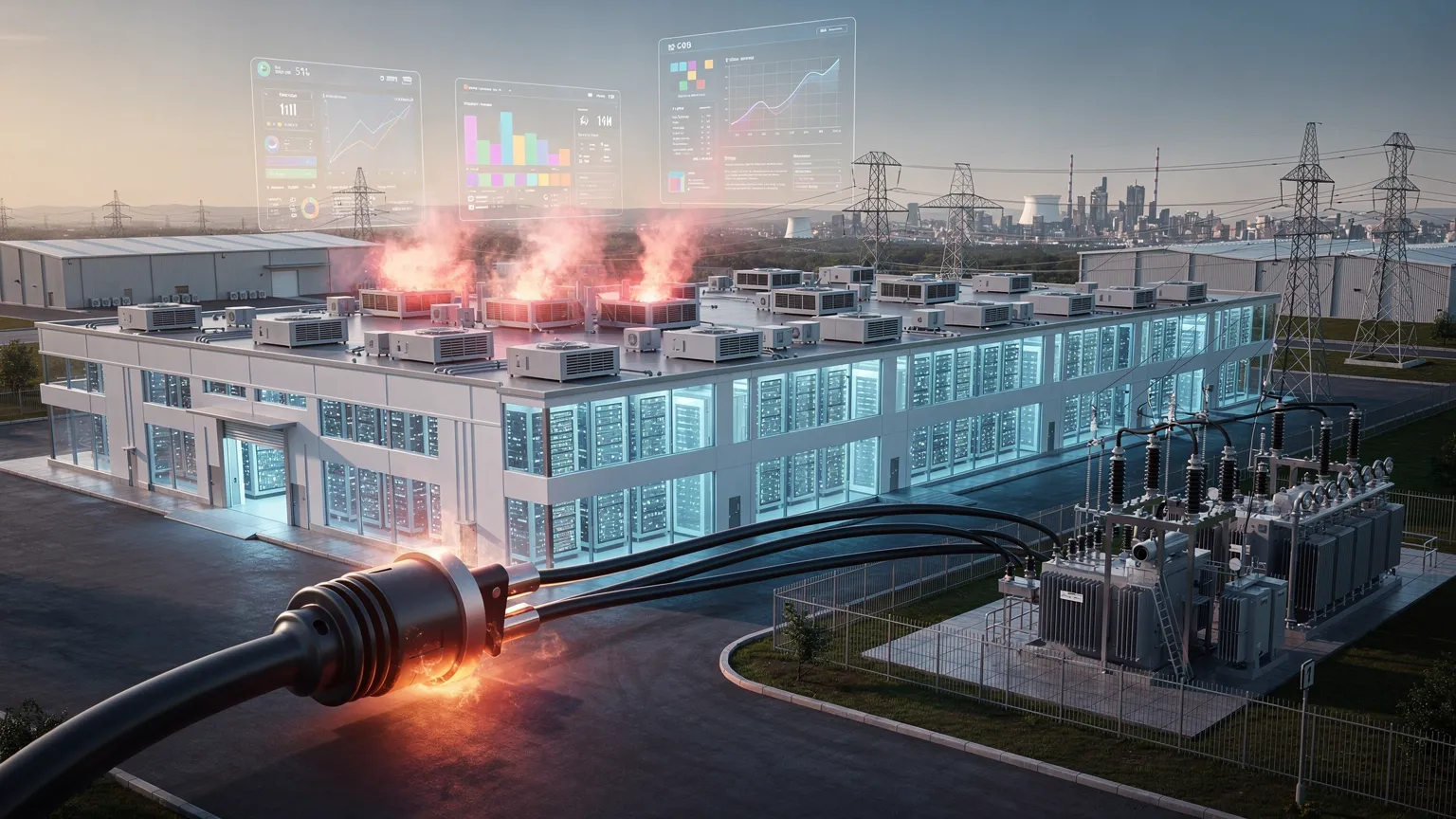
This changes competitive dynamics. Companies with reliable access to suitable sites and electricity may be able to deploy computing capacity sooner than competitors with similar budgets.
The effects are local. A data center located near spare generation capacity presents different challenges from one connected to a congested grid.
Will data centers increase electricity prices?
Large new electricity loads can create a need for grid and generation investment. Depending on tariff rules and how costs are allocated, other consumers may share some of those expenses.
But higher prices are not inevitable everywhere. Additional demand can sometimes improve the utilization of existing infrastructure. The consequences depend on local capacity, regulation, electricity contracts and whether facilities can reduce consumption during periods of system stress.
The relevant questions are who pays for new infrastructure, how quickly supply can expand and what reliability requirements the facility imposes.
Renewable energy, nuclear power and natural gas
Technology companies are exploring several approaches to securing power.
Wind and solar generation can supply low-carbon electricity, often through long-term purchase agreements. Their variable output requires appropriate balancing and reliability arrangements.
Nuclear generation can provide low-carbon electricity without depending on weather, but new projects may have long construction timelines and regulatory challenges.
Natural gas generation is another option, including proposals for onsite generation where grid connections are delayed. It can increase emissions and introduces fuel and equipment dependencies.
No single source solves every problem. Reliability, cost, development time, local regulation and carbon intensity all matter.
Carbon emissions and water use
Electricity consumption is not the same as greenhouse gas emissions. The emissions associated with a data center depend substantially on the electricity used, as well as equipment manufacturing and construction.
Water footprints also vary. Some cooling designs use evaporative systems; others use different methods. Electricity generation and semiconductor manufacturing can add indirect water consumption.
Claims that every AI request has a fixed electricity or water footprint oversimplify a system in which location, hardware, workload and operating conditions vary significantly.

Transparent reporting should distinguish total data center activity from AI-specific workloads, and operational impacts from lifecycle impacts.
Will efficiency improvements reverse the trend?
AI hardware and software are becoming more efficient. Quantization, smaller specialized models, caching, batching and improved inference scheduling can reduce the resources needed for a particular task.
Yet lower costs can encourage wider use. More applications may incorporate AI, and some users may demand increasingly computationally intensive services.
Consequently, energy consumption per task can fall while aggregate electricity demand rises. Efficiency improvements are important, but their net effect must be measured against adoption and workload growth.
AI can also improve energy systems
AI can assist with demand forecasting, grid maintenance, renewable generation forecasting and industrial process optimization. These applications may help operators use infrastructure more effectively.
Potential benefits should not automatically be treated as offsets for AI's own electricity consumption. Actual savings depend on deployment quality, data access, governance and measurement.
What developers and businesses can do
Software teams can avoid unnecessary computation by selecting appropriately sized models, caching repeatable results, reducing redundant requests and measuring real workload costs. Businesses procuring AI services should consider reliability, pricing transparency, data residency and environmental reporting.
Infrastructure operators should plan power supply, cooling, grid access and equipment procurement together, rather than treating electricity as an afterthought.
Conclusion
AI competition is no longer only about algorithms and processors. Electricity infrastructure, cooling technology, grid access and energy supply chains now influence how quickly computing capacity can be deployed.
The IEA's projection of approximately 950 TWh of global data center electricity consumption by 2030 illustrates the scale of the challenge, but the outcome remains uncertain. Better hardware, smarter software, grid investment and responsible planning will all shape the result.
The next stage of the AI revolution will be shaped not only by what computers can calculate, but also by how efficiently and reliably we can power them.